

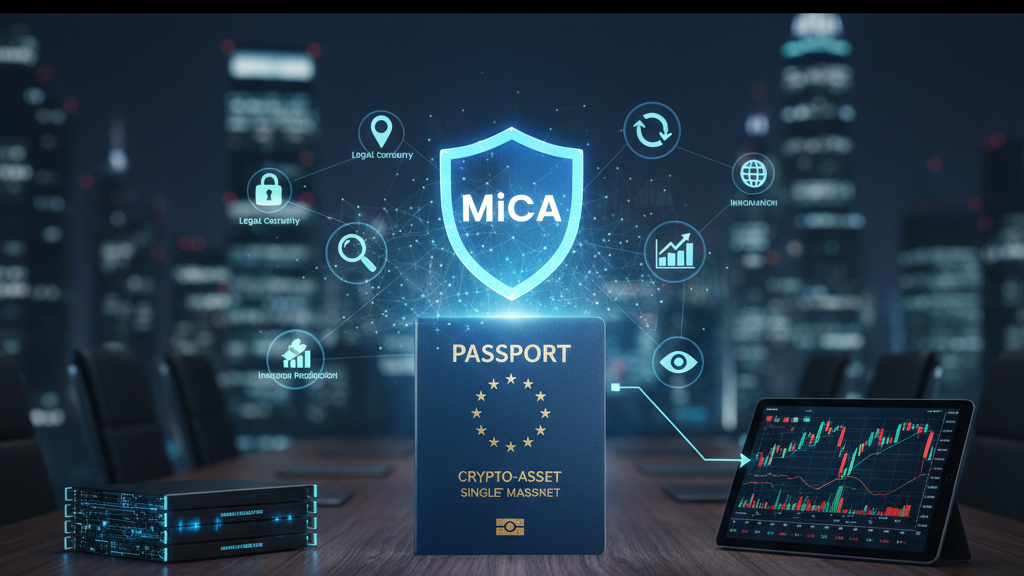
The European Union has decisively cast its regulatory die. With the Markets in Crypto-Assets Regulation, or MiCA, the bloc isn’t just catching up to the digital asset market; it’s architecting its future. MiCA is arguably the most significant piece of crypto legislation globally, replacing a fragmented patchwork of national rules with a unified, pan-European framework. Its core mission is clear: to institutionalize the crypto economy by delivering legal certainty, ensuring financial stability, and rigorously protecting consumers.
This isn’t a meek embrace of innovation; it’s a calculated, prescriptive mandate designed to compel global participation under the EU’s banner. By establishing a clear, single rulebook for a market previously defined by ambiguity, Europe is sending a powerful signal to institutional capital and sophisticated actors worldwide: if you seek clarity and scale, the EU is now your base.
The Foundation of the New Digital Market
MiCA’s genius lies in its comprehensive taxonomy and the mandatory licensing it imposes. It meticulously separates regulated assets into categories, most critically differentiating between:
- E-Money Tokens (EMTs): Stablecoins pegged to a single fiat currency (like the Euro). These are treated like electronic money and face stringent prudential rules.
- Asset-Referenced Tokens (ARTs): Stablecoins backed by a basket of assets, like currencies or commodities.
- Utility/Exchange Tokens: All other non-security crypto-assets.
The regulation of stablecoins is the most immediate and impactful component, fully applicable since June 30, 2024. Recognising their systemic risk potential, the EU demands that EMT issuers hold conservative, one-for-one reserves in bankruptcy-protected structures. This strict prudential standard, enforced by the European Banking Authority (EBA), is explicitly designed to prevent the “bank-run” scenarios that have plagued the global stablecoin market, anchoring trust at the very core of digital payments.
For Crypto-Asset Service Providers (CASPs)—the exchanges, custodians, and brokers—MiCA introduces a mandatory, EU-wide authorisation regime. Once licensed in one Member State, a CASP receives a regulatory “passport” to operate across the entire single market. This pan-European licence is a game-changer, eliminating the costly and complex need for firms to seek separate approvals in 27 different jurisdictions. These licensed firms are subject to high standards of operational resilience (linked to the Digital Operational Resilience Act – DORA), secure client asset handling, and mandatory, sophisticated complaint procedures.
MiCA goes further, importing traditional finance rules to preserve market integrity. A quasi-Market Abuse Regulation (MAR) approach bans insider dealing and market manipulation for crypto-assets traded on a CASP platform. This places a heavy operational burden on CASPs to implement robust surveillance systems—a true sign that the EU views regulated crypto trading as functionally equivalent to traditional financial market infrastructure.
The Compliance Acceleration Paradox
While the “Level 1” MiCA text provides the high-level vision, its practical implementation hinges on the ongoing finalisation of hundreds of pages of Level 2 and Level 3 technical standards (RTS, ITS, and Guidelines) by the European Supervisory Authorities (ESMA and EBA).
This phased approach, with full application for CASPs set for December 30, 2024, presents what can be called the Compliance Acceleration Paradox. Firms must rapidly build costly compliance infrastructure based on a technical rulebook that is still being written. This regulatory design inherently favours large, established institutions with the legal and financial resources to track, interpret, and rapidly integrate the evolving mandates. The challenge for smaller innovators is steep, but the reward—a compliant path to the world’s largest single market—is undeniable.
Strategic Gaps and the Global Competitive Edge
Despite its comprehensive nature, MiCA contains strategic exclusions that set the stage for future regulatory battles:
- The DeFi Dilemma: MiCA generally excludes services provided in a “fully decentralised manner without any intermediary.” This is a calculated deferral, acknowledging the near-impossibility of regulating pure code. However, it creates a risk of regulatory arbitrage, where teams may try to structure protocols to look “decentralized” purely to escape the perimeter, potentially pushing high-risk activity outside of EU supervision.
- NFTs and Overlap: The regulation does not offer comprehensive coverage for most Non-Fungible Tokens (NFTs), leaving a rapidly growing segment of the digital economy in a grey area unless they qualify as fractionalised securities.
Crucially, MiCA takes an unyielding stance on global access: it lacks a permissive third-country regime. This means non-EU firms that want to serve the EU market cannot simply operate from their home country; they must onshore and obtain a full EU MiCA licence. This rigorous jurisdictional requirement is a strategic move to compel global operators to submit to EU law and supervision, ensuring the bloc’s digital financial sovereignty.
MiCA vs. The World
MiCA’s proactive, unified approach stands in stark contrast to the regulatory landscapes of its global peers:
- The United States: The US remains characterised by fragmentation and an enforcement-led approach. Regulators like the SEC and CFTC assert jurisdiction primarily through litigation under decades-old securities and commodities laws, fostering a climate of profound regulatory uncertainty that MiCA was designed to eliminate.
- The United Kingdom: The UK is pursuing a phased approach, integrating crypto-asset activities into its existing financial services law. While the UK’s initial scope is narrower—focused on stablecoins for payment and tightening financial promotions—there is a transatlantic convergence emerging, especially around the prudential safeguards for stablecoins, signaling a developing global consensus on key risks.
MiCA is not just a piece of legislation; it is Europe’s blueprint for the future of digital finance. It declares that regulation is not a barrier to institutional scale but its very foundation. By providing the clearest path to a massive, single market, the EU has seized a significant first-mover advantage, effectively compelling the global industry to play by its rules to access European investors and consumers.
The challenge now shifts from legislative writing to flexible, effective supervisory enforcement. Whether the EU can maintain its regulatory clarity while adapting to the relentless pace of decentralised innovation will determine MiCA’s ultimate legacy and the future trajectory of global digital asset markets.

