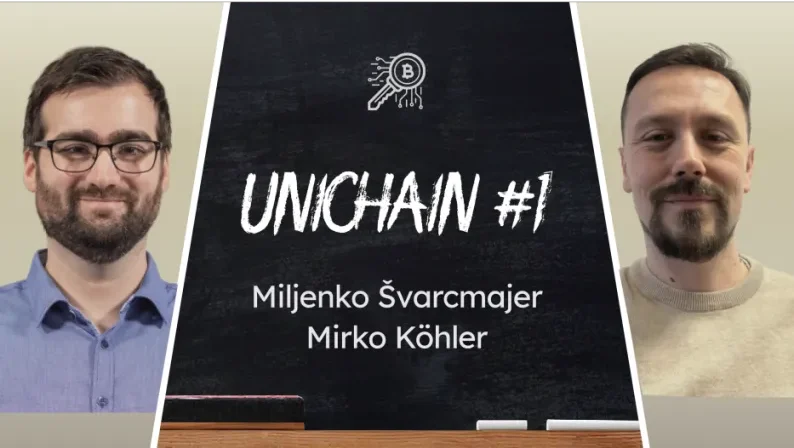
In this exclusive interview, we sit down both with associate professor Mirko Köhler and assistant Miljenko Švarcmajer, both of who work at the Faculty of Electrical Engineering, Computer Science and Information Technology Osijek in their respectful roles. The Faculty of Electrical Engineering, Computer Science, and Information Technology Osijek is a progressive institution that continuously advances in its fields of expertise. Its education system is structured across three levels, with study programs regularly updated to align with the latest scientific developments, economic trends, and job market demands. The Faculty’s research teams have actively contributed to numerous national and European projects, both as leaders and collaborators.
The faculty strives towards genuine progress in various fields, one of which is blockchain development, Köhler and Švarcmajer will share their opinions on several topic, transitioning from Web2 to Web3 and to what can students expect in the new said Web. Join us in this very interesting insight of blockchain development in the education field
- How significant was the Transition from Web2.0 to Web3.0?
I initially struggled to accept the necessity of transitioning from Web 2.0 to Web 3.0. My doctoral research focused on clustering, and my teaching primarily involved web development—HTML, CSS, JS, and PHP. I saw Web 3.0 as a major challenge because it changed the entire paradigm of a world I was very familiar with. However, its significance is undeniable. Today, blockchain technology is my primary research focus, and consequently, Web 3.0 as well. The decentralization introduced by Web 3.0 has transformed how people think about using the Internet. In my opinion, this is the most important impact of the new technology. People no longer seek permission from centralized authorities but instead find ways to solve problems without them. New economic models enabled by tokenization and blockchain technology are still being developed, and I believe they will shape the future. However, we must acknowledge that Web 3.0 still faces many challenges that need to be addressed.
– Köhler
- What are your opinions on the widespread adoption of blockchain technology in today’s industry, and how can it contribute?
Although many associate blockchain solely with cryptocurrencies, its application offers significant advantages across various industries. Key blockchain properties—decentralization, data immutability, distribution, traceability, security, and transparency—allow for its broad use in different systems.
Additionally, blockchain has evolved alongside other technological advancements, resulting in numerous specialized solutions tailored to specific industry needs. Today, different blockchain systems are optimized for particular purposes, and further customization is possible by selecting the appropriate consensus mechanism. Given the wide range of available consensus models, it is possible to find the best fit for each industrial application—whether improving supply chain efficiency, ensuring data integrity in healthcare, or enhancing financial transaction security.
The key to successfully implementing blockchain in industry lies in thoroughly understanding business processes and carefully selecting technological components to achieve maximum efficiency and scalability.
– Švarcmajer
- What is the most interesting blockchain-based project you have had the opportunity to collaborate on?
One project that comes to mind is “Metroracle – Oracles compliant to metrology standards,” which emerged from the need to enhance trust in measurement data from IoT devices. The project was funded by NGI-TRUBLO. We used a blockchain oracle to validate measurement data and its metadata. However, your readers may struggle to find information about this project, as a company (which we won’t name) had an issue with the project name, forcing us to take down the website.
Another ongoing project, which I am working on with my colleague Švarcmajer, is “Research on Advanced Algorithms and Innovative Business Intelligence Solutions in the Cloud.“ Our role in this project is to ensure the traceability of documents used by large language models (LLMs) to learn and make decisions, utilizing blockchain technology.
– Köhler
- Do you teach any courses related to blockchain technology, decentralization, or similar topics at your faculty? Can you briefly describe the course and its core focus?
We have two courses that are exclusively focused on blockchain. The first, “Application of Blockchain Technology,” is part of the professional study program, where my colleague and I collaborate. The second, “Blockchain Technology and Cryptocurrencies,” is a mandatory course in the Master’s in Computer Science – Data Science module, which I lead.
This course introduces blockchain technology, its most well-known applications in both public and private sectors, and a comprehensive approach to the technology through business solutions and cryptocurrencies. We explain the concept of the ledger and the advantages of combining it with P2P network architecture. We provide an introduction to encryption techniques and the use of hash functions.
Students learn about decentralization, its benefits, and its drawbacks, as well as anonymity in blockchain. Since cryptocurrencies remain the most widespread use case of blockchain, we cover Bitcoin and alternative cryptocurrencies in detail. We also emphasize different consensus mechanisms and discuss the future of blockchain, cryptocurrencies, and other distributed ledger technologies.
By the end of the course, students should be able to explain the reasons for using blockchain technology, describe its advantages, and apply it in practice. They must learn to use existing blockchain systems and create their own. As we are a computer science faculty, students are also expected to develop new software solutions using blockchain knowledge.
– Köhler
- Have you noticed an increase in interest in blockchain technology and decentralization among students in relation to your courses?
Blockchain-related courses are currently offered as electives in the third year of the professional computer science program and the second year of the master’s program. Interest in the master’s course is so high that enrollment slots are always full, and we even considered increasing the number of groups to accommodate more students.
There has been a continuous increase in interest in this topic, driven in part by media coverage of cryptocurrencies and blockchain, but also by our approach to teaching, which emphasizes practical applications. Students are highly engaged—not just during lectures but also through follow-up discussions in hallways and even outside class hours.
Additionally, many students independently request extra materials for further study and seek guidance on projects and research papers. The growing number of master’s theses on blockchain topics further confirms that blockchain is not just a passing trend but an area where students recognize long-term opportunities and practical applications.
– Švarcmajer
- How valuable do you think blockchain knowledge is for technically skilled students entering the job market?
Our faculty’s strategy is to closely collaborate with the industry. Our primary partners are local businesses, followed by national and international partners. The demand from the industry for blockchain-educated graduates led to the creation of these courses.
Web 3.0 is the future, and there is no question that these skills will benefit students in the job market. Recently, we hired young researchers for a project, and all of them had encountered Web 3.0 technologies at some point.
– Köhler
- Do you have any plans to promote blockchain technology through new courses or faculty projects in the coming academic years?
Beyond promoting blockchain technology through coursework and encouraging students to explore this field, we are also planning additional initiatives to expand interest and application of blockchain.
One major change is transitioning blockchain courses from electives to mandatory courses, ensuring that a significantly larger number of students gain foundational knowledge of the technology and its industry applications.
Additionally, we are working on collaborations with professors from other faculties who organize informal lectures and gatherings for students interested in blockchain. We take inspiration from successful initiatives like Blockchain at Berkeley (B@B), where students not only study and research blockchain but also launch their own startups. Similar initiatives already exist in Croatia, such as the Riteh Blockchain Team, and we plan to establish a student organization at our faculty as well.
The goal of this organization is to help students engage with the blockchain community earlier in their studies rather than waiting until their final years. Since blockchain courses are becoming mandatory, we anticipate a rise in student interest for further research and practical application.
At the same time, we are applying for EU projects that will allow us to fund research and development in this field while also hiring young researchers from our recent graduates. This approach fosters innovation, strengthens the connection between academia and industry, and enables students to apply their knowledge in real-world projects immediately after graduation.
– Švarcmajer