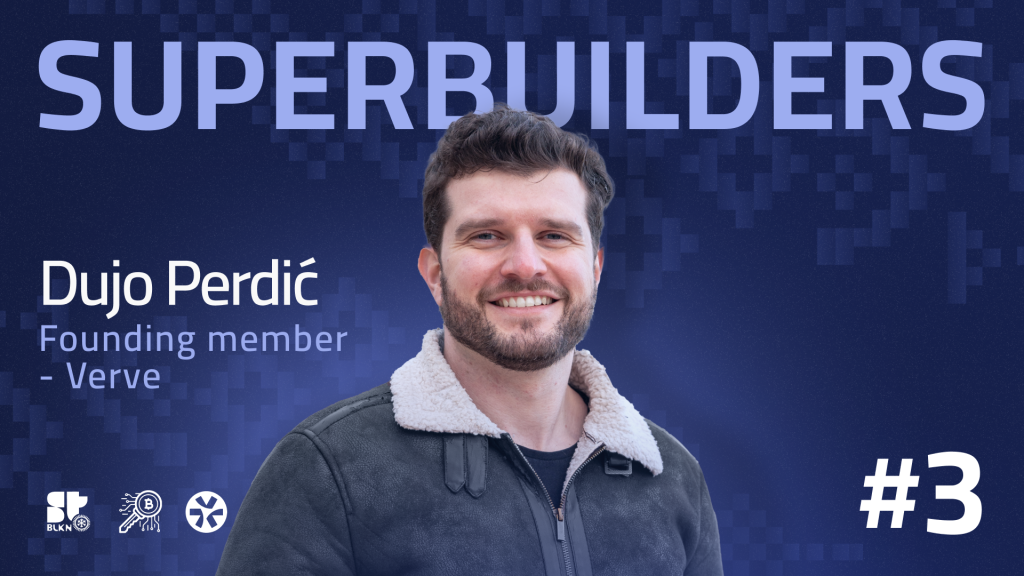
Dujo Perdić is a talented full-stack developer passionate about software development and learning new technologies. With experience in EdTech and WebVR, he has also explored the realms of Web3 and AI, showcasing his adaptability and forward-thinking approach. Recently, Dujo completed an internship with Solana, where he deepened his expertise in blockchain technology and contributed to innovative projects.
- Can you share your background before joining the Solana internship?
Before joining the Solana internship, I spent six years as a Web2 developer. My journey began in EdTech, where I developed and maintained school management software, helping streamline operations for language schools. Later, I transitioned into freelance work in the WebVR space, exploring immersive technologies and lastly, co-founded Linguapop – a language placement testing platform for schools alongside Jure Granić Skender and Paula Rosan.
My introduction to the Solana ecosystem was through the first-ever Solana BuildStation in Split, which I attended with Jure and Paula. Our team secured second place in the competition, which inspired us to pivot our focus towards Solana. Continuing the theme of hackathons, we participated in Bonkathon by RadiantsDAO and won 3rd place in the consumer app track with BonkArt – a pixel placing game that emulates Reddit’s r/place event on Solana.
- What inspired you to apply for the Solana internship program?
While we were figuring out our next steps, I came across a post in the Superteam Balkan Discord server one day about the Solana internship.
I was eager to push myself beyond my comfort zone and dive deeper into something new. The Solana internship program seemed like the perfect opportunity to challenge myself, expand my knowledge, and gain hands-on experience with Solana development.
- How would you describe the application and selection process?
The Solana internship was focused on finding candidates with a proven track record of building and shipping products. Having a background in Solana wasn’t a requirement, which made the program accessible to developers eager to learn.
The application process itself was pretty straightforward. I submitted my socials and GitHub profile to showcase my work and included a motivation letter to explain why I was a great fit. The second phase consisted of a quick interview, which mainly assessed my commitment to the program.
Out of around 1000 applicants, only about 40 of us were selected.
- What were your main responsibilities and projects during the internship?
During the internship, our main responsibilities centered on learning, practicing, and building within the Solana ecosystem. Each week, we had an hour-long lesson that covered a specific aspect of Solana development, such as working with Anchor, creating native Solana programs using only Rust, creating frontend apps to interact with on-chain programs, creating Solana mobile apps and working with NFTs and cNFTs. These lessons were paired with assignments designed to help us apply what we’d learned in a practical, hands-on way.
In addition to the weekly lessons and assignments, we were also tasked with developing a project Demo Day at the end of the internship. This project was an opportunity to take everything we had learned and build something that would showcase what we’ve learned during the internship. Two of the best projects would win a ticket to Solana Breakpoint 2024 in Singapore and I was one of the winners.
For my Demo Day project I decided to make a Solana based Conway’s Game of Life where a player would connect their wallet, place the pixels on the board, mint an NFT and play the simulation of the shape they created. The player could also give their NFT to someone else so they could play the simulation.
- What did you learn or gain from this experience?
I learned a ton from this experience, especially on the development side. The assignments and projects gave me hands-on skills in Solana’s ecosystem.
What made the internship even more special was the camaraderie. A lot of us bonded over shared challenges, whether it was troubleshooting code or figuring out a tricky concept.
On top of that, we had the chance to learn directly from Solana veterans like Stepan from Squads, Andrew Lee from Sphere, and Shek from Superteam India. Their insights and guidance were invaluable, and it was inspiring to hear from people who are at the forefront of the ecosystem.
- What challenges did you face, and how did you overcome them?
One of the biggest challenges during the internship was that a lot of Solana’s documentation was being rewritten at the time. This made it pretty frustrating to find the right resources for certain tasks, especially when we needed something specific.
But we made it work by sharing resources we found in the Discord. When one of us figured something out, we’d share it, and that teamwork helped fill in the gaps. The instructors were also really supportive, always ready to step in when we needed help.
- How has the internship shaped your future career plans?
The internship has given me a solid background in Solana Development as well as a fundamental understanding of how state compression works on Solana which would prove invaluable when working on Verve with Jure and Paula.
This knowledge helped us secure 4th place in the Colosseum’s Radar hackathon in the infrastructure track and 2nd place in the ZK Compression sidetrack by Light protocol.
- What are your thoughts on the future of Solana and blockchain technology?
One major trend I see is the combination of AI agents and blockchain. Imagine AI agents with dedicated wallets or the ability to connect to users’ wallets. Users could simply chat with the agent – via platforms like Telegram or Discord – to perform blockchain transactions. This integration could make blockchain technology far more accessible and user-friendly.
Another big trend I see in Solana is the shift towards account abstraction. With account abstraction, users could create and manage wallets using socials like Google Sign-In or passkeys, similar to how embedded wallets on Solana currently work.
The difference is that most embedded wallets today rely on multi-party computation (MPC), where the wallet provider holds a portion of the private key. While this allows for convenient sign-ins using socials or passkeys, it also ties users to the provider’s infrastructure. Account abstraction, on the other hand, removes this dependency. Users could manage their wallets independently of any provider, ensuring full control as long as the blockchain exists.
This is a problem we’re aiming to solve with Verve – enable users to have a web2-like experience while being in full control of their wallet.
We also see Verve as the go-to wallet for AI agents since users can define the limits of what the AI agent can do with the wallet with our account guardianship model enabled by account abstraction.