

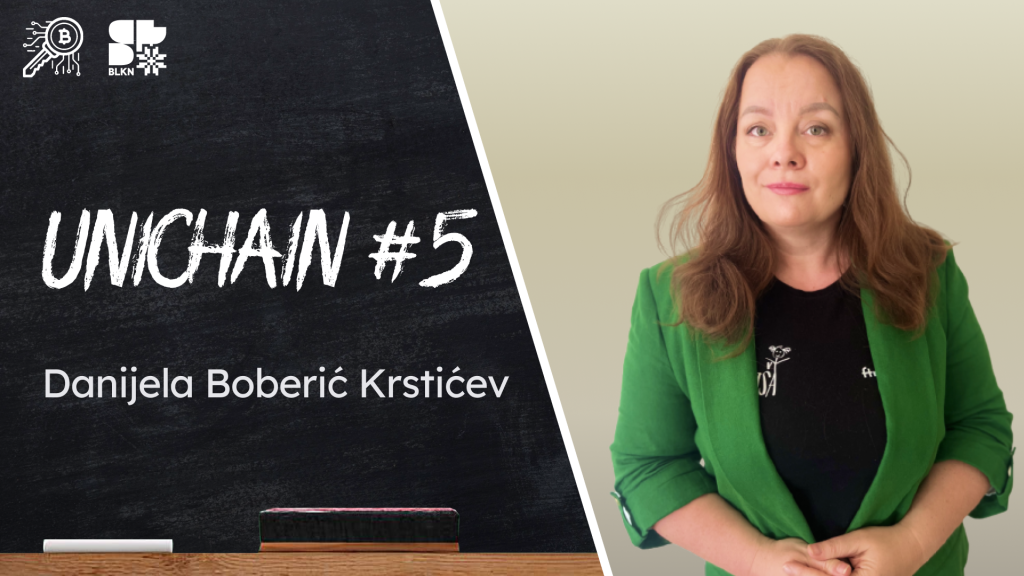
Danijela Boberić Krstićev is an Associate Professor of Information Systems at the University of Novi Sad. She holds a PhD in Computer Science and specializes in areas such as object-oriented design and modeling. Her expertise encompasses software modelling and development with the focus on cybersecurity. In recent years, her expertise is complemented by a growing interest in big data analytics. She is actively involved in several EU projects and has published over 30 journal and conference papers.
- How did your academic background in information systems and computer science lead you to explore the fields of blockchain and cybersecurity?
My academic background in information systems and computer science provided a strong foundation in both the technical and organizational aspects of digital technologies. As I delved deeper into system design, data management, and distributed computing, I became increasingly interested in how trust, security, and transparency are managed in complex digital ecosystems. This naturally led me to explore blockchain, which offers innovative solutions to these challenges through decentralized architectures and cryptographic principles.
At the same time, I recognized that cybersecurity is a critical component of any robust information system. Understanding how to protect systems, data, and users from threats became essential – not just technically, but also from a governance and risk management perspective. The intersection of blockchain and cybersecurity intrigued me, especially how blockchain could be leveraged to enhance security in areas like identity management, secure data sharing, and auditability.
- In your view, what are the most promising use cases of blockchain technology outside of cryptocurrencies?
One of the most promising applications of blockchain is in supply chain management. Blockchain provides end-to-end traceability, enabling companies to track products from their origin all the way to the consumer. This is especially important in industries like food and pharmaceuticals, where ensuring safety, authenticity, and quality is critical. By using blockchain, companies can more easily detect fraud, reduce inefficiencies, and increase transparency throughout the entire supply chain.
- Cybersecurity is a growing concern in the era of decentralized technologies. How can blockchain help enhance security frameworks in digital systems?
One particularly promising application of blockchain for enhancing cybersecurity lies in securing the software supply chain, especially through managing dependencies and tracking vulnerabilities using Software Bill of Materials, or SBOMs. Modern software relies heavily on numerous external libraries, each introducing potential security risks.
An SBOM captures critical metadata about these libraries—their origin, version history, and known security assessments. However, maintaining trust in this data as it moves across projects and organizations remains a challenge. Blockchain may address this by recording SBOM entries and their associated security evaluations on an immutable, tamper-proof ledger. This creates a verifiable and transparent history of each software component’s security posture. When incorporating a dependency into a new project, developers can consult the blockchain to confidently assess its provenance and audit history without needing to re-verify from scratch. This approach reduces redundant security audits while strengthening accountability and trust in the software development lifecycle. By bringing transparency to a complex and increasingly targeted area, blockchain helps digital systems build stronger, more reliable security frameworks against evolving threats.
- What are the main vulnerabilities you see in current blockchain implementations, particularly in smart contract platforms?
While I’m not a blockchain expert, I can see some security issues. For example, smart contracts are often written in languages like Solidity, which are still maturing and can be prone to developer mistakes. Many projects lack rigorous security audits and rely too heavily on the assumption that “code is law.” But in practice, poorly tested contracts can become high-value attack targets. Also, even the most secure blockchain protocol can be undermined by poor key management. From phishing attacks to stolen keys, human error and social engineering remain some of the most exploited weaknesses – something very familiar in traditional cybersecurity.
- How do you balance the need for transparency in blockchain systems with the growing demand for data privacy and protection?
In my opinion, a key way to balance transparency and privacy in blockchain systems is through the use of off-chain solutions. Instead of storing sensitive or personal data directly on the blockchain, which is public and immutable, the actual data is kept off-chain in secure, controlled environments.
On the blockchain itself, only cryptographic proofs or hashes of that data are recorded. This approach ensures that the blockchain maintains its transparency and auditability – because anyone can verify that the data hasn’t been tampered with by checking the hash – while protecting privacy by keeping the detailed information off the public ledger. It effectively separates data integrity from data confidentiality, allowing systems to comply with privacy requirements without sacrificing trust and verification capabilities.
- Have you been involved in any research or development projects where blockchain was used for secure data sharing or digital identity management?
Yes, I’ve been involved in the EU Horizon project called RESCALE, which leverages blockchain technology to enhance security and trust in the software supply chain. Although the focus isn’t specifically on digital identity management, the principles of secure data sharing, provenance tracking, and decentralization are at the core of the project.
One of the key components we worked with was the Trusted Bill of Materials (TBOM) – an evolution of the traditional SBOM concept. In RESCALE, blockchain is used to store TBOM data in a tamper-proof and verifiable way. By anchoring this information on the blockchain, we ensure that any stakeholder ( developers, auditors, or integrators) can verify the integrity and trustworthiness of a software or hardware component without relying on centralized authorities. It was a valuable experience that demonstrated how blockchain can support security – critical infrastructures beyond cryptocurrencies.
- From an educational standpoint, how important is it to integrate blockchain and cybersecurity into university curricula today?
Integrating blockchain and cybersecurity into university curricula is not just important – it’s essential. As systems become more interconnected and decentralized, understanding how to secure them is a foundational skill for the next generation of engineers, developers, and IT professionals. Cybersecurity is no longer a niche discipline; it’s a core concern across virtually every industry. Embedding cybersecurity principles into the curriculum ensures that students learn to design systems with security in mind from the ground up, rather than treating it as an afterthought.
Likewise, blockchain is a transformative technology with applications well beyond cryptocurrencies—such as secure data sharing, identity management, and supply chain integrity. Educating students about blockchain helps them understand how decentralization, consensus mechanisms, and cryptographic tools can be used to build trust in digital systems.
- What trends do you foresee shaping the future intersection of blockchain technology and cybersecurity in the next five years?
As someone coming from a cybersecurity background, I see several important trends at the intersection of blockchain and security over the next five years. We’ll likely see broader adoption of secure coding frameworks, formal verification tools, and automated vulnerability scanners for smart contracts. Security will become a standard part of the development lifecycle – much like DevSecOps has in traditional software engineering.
Also, blockchain itself will increasingly be used as a tool to enhance cybersecurity, especially for supply chain security. We’ll likely see more international standards and regulatory frameworks for blockchain security, pushing platforms to comply with security best practices. Overall, I believe the convergence of blockchain and cybersecurity will drive innovations that not only harden blockchain platforms themselves, but also use them as tools to solve long-standing cybersecurity challenges.