

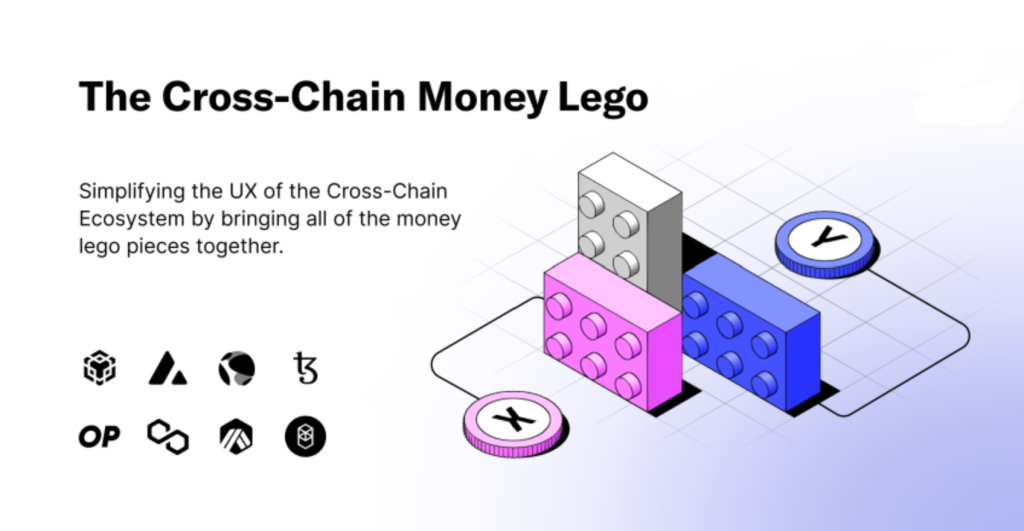
“Money Legos” is a popular phrase in the community that defines composability. This is an important feature for building new protocols, dApps, and smart contracts that can function independently or together on the same chain or multiple chains. This perspective on architecture is fundamental to the development of DeFi as it allows for increased efficiency and synergies that would not be possible in isolated financial systems.
When protocols build on one other’s capabilities, they produce a flywheel effect of innovation, resulting in increased liquidity, modular architecture, and layered functionality. One notable example of cross-chain composability is Wormhole, a cross-chain interoperability protocol that connects 17 high-value blockchain ecosystems. Its secure communications technology enables tokenized asset transfers and on-demand data access across chains. Let’s take a closer look at how this composability framework promotes innovation, using Wormhole as an example.

Composability: The Foundation of a Modular Ecosystem
Composability refers to the ability for different components or elements to be combined or connected in various ways to create larger, more complex systems or structures. It’s a concept often used in the context of software development, computer systems, and engineering, but it applies to other fields as well. Composability allows individual DeFi protocols to act as modular components that developers can integrate, reconfigure, or enhance to create entirely new use cases. These interactions can occur either within the same blockchain or across multiple chains, with each layer adding new dimensions of functionality.
At its core, composability is about permissionless innovation. Developers can leverage existing protocols, such as automated market makers (AMMs), lending platforms, oracles, and bridges, without needing explicit permission from their creators. This open architecture accelerates development cycles and fosters a dynamic ecosystem where the emergence of one protocol often catalyzes the evolution of others.
For example:
- Aave’s lending markets can integrate with Balancer’s liquidity pools to optimize collateral management.
- Chainlink oracles provide real-time price feeds that underpin liquidations in lending platforms like Compound.
- Yearn Finance aggregates yield strategies from various protocols, creating value through composability at scale.
While these examples demonstrate same-chain composability, the next frontier lies in cross-chain composability, which expands the scope of interaction beyond the boundaries of a single blockchain.
Cross-Chain Composability: Unlocking New Dimensions
The rise of Layer-1 blockchains such as Solana, Binance Smart Chain (BSC), and Avalanche, alongside Ethereum, has created a multi-chain DeFi ecosystem. However, these chains operate as independent silos, each with unique protocols, token standards, and liquidity pools. Cross-chain composability addresses this fragmentation by enabling seamless interactions across ecosystems, effectively unlocking the latent potential of multi-chain DeFi.
Wormhole: A Cross-Chain Innovation Catalyst
Wormhole exemplifies the power of cross-chain composability by acting as a universal communication bridge. By facilitating secure and efficient transfers of value and data across 17 high-value chains, Wormhole transforms fragmented ecosystems into an interconnected network of possibilities.
Bridging Liquidity Across Ecosystems
One of Wormhole’s most significant contributions is its ability to move liquidity across chains. For example, developers can transfer Ethereum-based assets to Solana to participate in Solana’s high-speed, low-cost DeFi markets. Conversely, Solana-native tokens can flow into Ethereum-based protocols to access Ethereum’s deep liquidity.
This functionality enhances capital efficiency by breaking the barriers of isolated liquidity pools. Assets are no longer confined to their origin chains, and users can deploy capital where it is most productive. For instance, a protocol like Kamino Finance on Solana can use Wormhole to integrate liquidity from Ethereum and BSC, enabling cross-chain yield strategies that maximize returns.
Enabling Layered Protocol Interactions
Wormhole doesn’t just move tokens; it facilitates the movement of data. This capability enables layered protocol interactions, where dApps can pull real-time data from one blockchain and use it on another. For instance, a lending protocol on Avalanche could use Wormhole to access Solana’s price oracles, ensuring accurate collateral valuations. This kind of inter-chain functionality creates new opportunities for innovation, such as cross-chain derivatives, multi-chain index funds, or decentralized insurance markets.
Flexibility Through Modularity
Wormhole’s modular architecture is another standout feature. Developers can choose their preferred verification and relaying methods, tailoring Wormhole’s functionality to their specific use cases. This flexibility ensures that the protocol remains adaptable as new blockchain technologies and standards emerge.

Why Composability Matters: Beyond Technical Synergies
The implications of composability go far beyond technical integrations. It drives the systemic evolution of DeFi by addressing three critical dimensions: liquidity, innovation, and resilience.
1. Liquidity as a Network Effect
Liquidity is the lifeblood of DeFi, and composability amplifies its impact. Cross-chain composability ensures that liquidity is no longer fragmented but flows seamlessly across ecosystems. Wormhole’s ability to connect 17 chains means protocols can tap into diverse liquidity pools, reducing inefficiencies and slippage for users. More liquidity translates into tighter spreads, better trading conditions, and enhanced market efficiency.
2. Innovation Through Synergy
Every composable interaction has the potential to unlock exponential innovation. For example, consider how a synthetic asset protocol like Synthetix could leverage Wormhole to collateralize assets from multiple chains. By combining cross-chain collateralization with real-time price feeds from Chainlink oracles, developers could create entirely new financial products, such as cross-chain perpetual swaps or global liquidity indexes.
This kind of synergy accelerates the pace of DeFi evolution. Developers are no longer limited by the constraints of individual ecosystems but can build applications that draw from the best features of multiple protocols and chains.
3. Resilience Through Decentralization
Composability also enhances the resilience of DeFi systems. By distributing functionality across multiple chains, protocols can mitigate risks such as downtime, congestion, or security breaches. If one chain faces performance issues, cross-chain solutions like Wormhole can reroute functionality to maintain operational continuity. This decentralization of operations reduces systemic risk and ensures a more robust DeFi ecosystem.
Case Study: Kamino Finance and Wormhole in Action
Kamino Finance, a Solana-based DeFi protocol, provides a compelling case study of Wormhole’s impact. By integrating Wormhole, Kamino extends its liquidity pools to include cross-chain assets such as W tokens and JitoSOL. This integration enables Kamino to offer unprecedented yield opportunities, such as a 999% weekly return on its liquidity pools.
Here, composability drives both user adoption and capital efficiency. Without Wormhole, Kamino’s ability to provide such high yields would be constrained by the liquidity available on Solana alone. Wormhole expands its reach, attracting more users and capital from other chains, and creating a virtuous cycle of liquidity and innovation.
The Road Ahead: Expanding the Composable Frontier
The future of DeFi hinges on the continued advancement of composability. As protocols like Wormhole enhance cross-chain capabilities, we are likely to see:
- Omnichain DAOs: Decentralized organizations that manage treasury and governance across multiple chains.
- Global Liquidity Networks: Unified liquidity pools spanning Layer-1 and Layer-2 chains, accessible from any blockchain.
- Interoperable DeFi Primitives: Building blocks such as lending, trading, and staking protocols that work seamlessly across ecosystems.
Conclusion
For a crypto-native audience, composability is not just a technical innovation but a philosophical shift that embodies the ethos of decentralization. By enabling protocols to collaborate within and across chains, composability creates a fertile ground for innovation, efficiency, and resilience.
Wormhole stands as a testament to this power, bridging ecosystems and pushing the boundaries of what DeFi can achieve. In a world increasingly defined by interconnected systems, composability ensures that DeFi remains at the forefront of financial innovation, unlocking new opportunities for developers, users, and communities alike.

